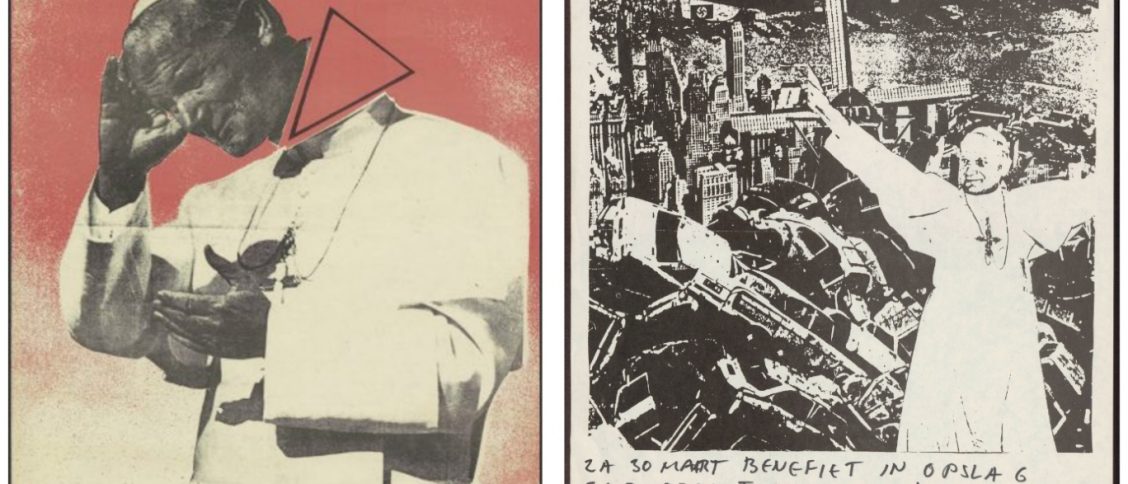
On May 11, 1985, Pope John Paul II kissed the ground of Welschap Airport near Eindhoven. It was the start of a “disastrous pope’s visit” (H). Demonstrations, protests, empty streets, and newspapers full of criticism. In IHLIA’s archives, there are six posters and a button related to this pope’s visit that make one thing very clear: gays and lesbians were angry. But why? What kind of posters are these, and who made them?
This research blog aims to share the process of my search for answers to these questions. The intersection of queer studies and historical or archival research remains under-explored. This blog could particularly be helpful for those who are interested in researching a topic on this intersection.
For a more elaborate description of the methodology and research process, see the research report.
For the full story about the pope’s visit to The Netherlands in 1985, see With Pride (in Dutch).
Context of the research
This research was conducted within the context of IHLIA, an archive for queer history in the Netherlands and beyond. My name is Iris Broekmann, and I study Global Project and Change Management at Windesheim Honours College in Zwolle. For my graduation thesis, I wanted to focus more on topics related to inclusivity, and the queer community particularly resonates with me. By preserving history and researching it, marginalized groups reclaim their place in history. We can learn from the mistakes that were made, and can base our current policies on these lessons, making them more inclusive.
Religion has always fascinated me, and after completing a minor in ‘World Religions, Philosophy, and Spirituality,’ I wanted to learn more about the role of religion in society and therefore chose to focus on the intersection between the queer community and religion, selecting Christianity in particular, because it has so strongly shaped Dutch society.
Researching objects
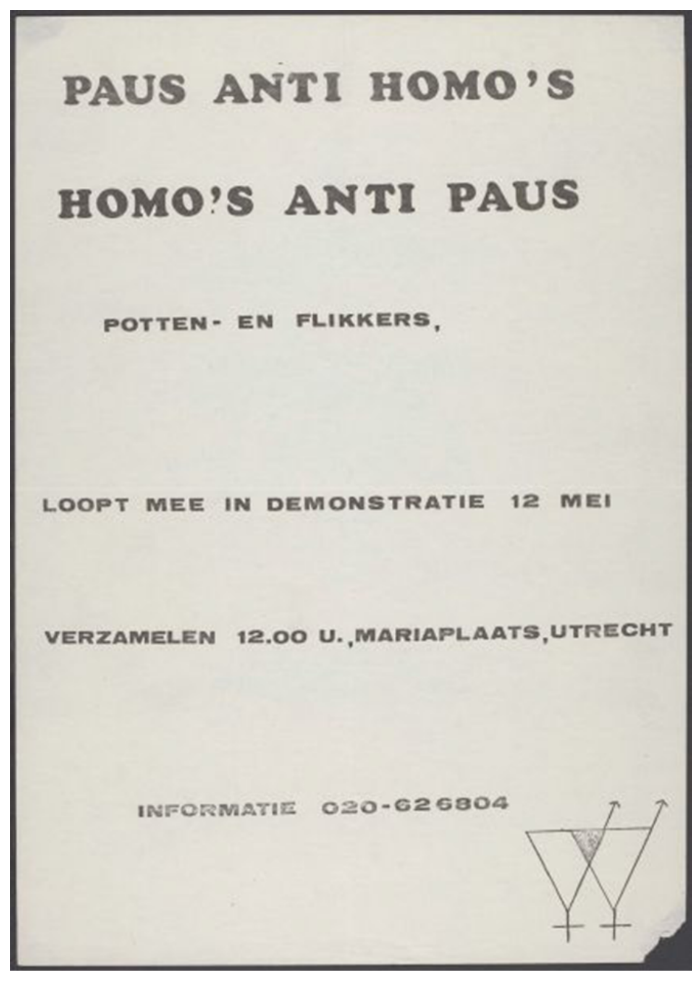
Based on the idea that objects appeal more to the general public than written texts, a decision was made to center this research around objects. In the archive, my attention was drawn to objects related to the pope’s visit to the Netherlands in 1985: A button with the pope’s face depicted in a shooting target, a poster calling for the liquidation of the pope during the visit, calls to attend the protest against the pope on 12 May in Utrecht, a call for a benefit evening in support of this protest, a slogan urging people to deregister from the Catholic Church, and a poster listing statements against the pope and the Roman hierarchy. Some of these posters are clearly queer, while this is not immediately apparent with others.
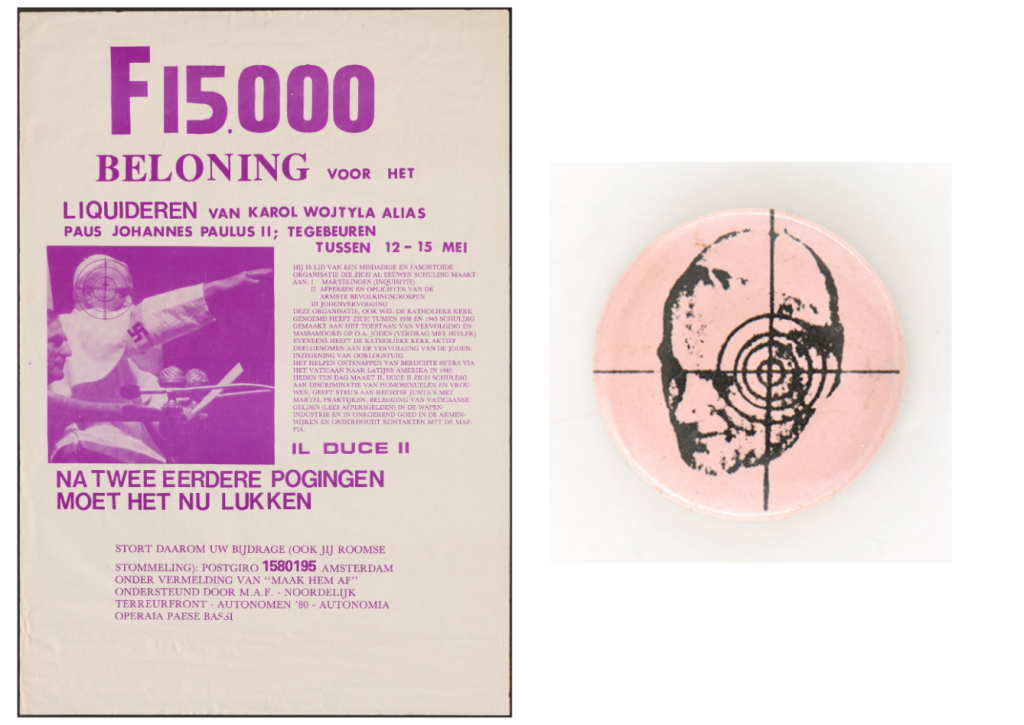
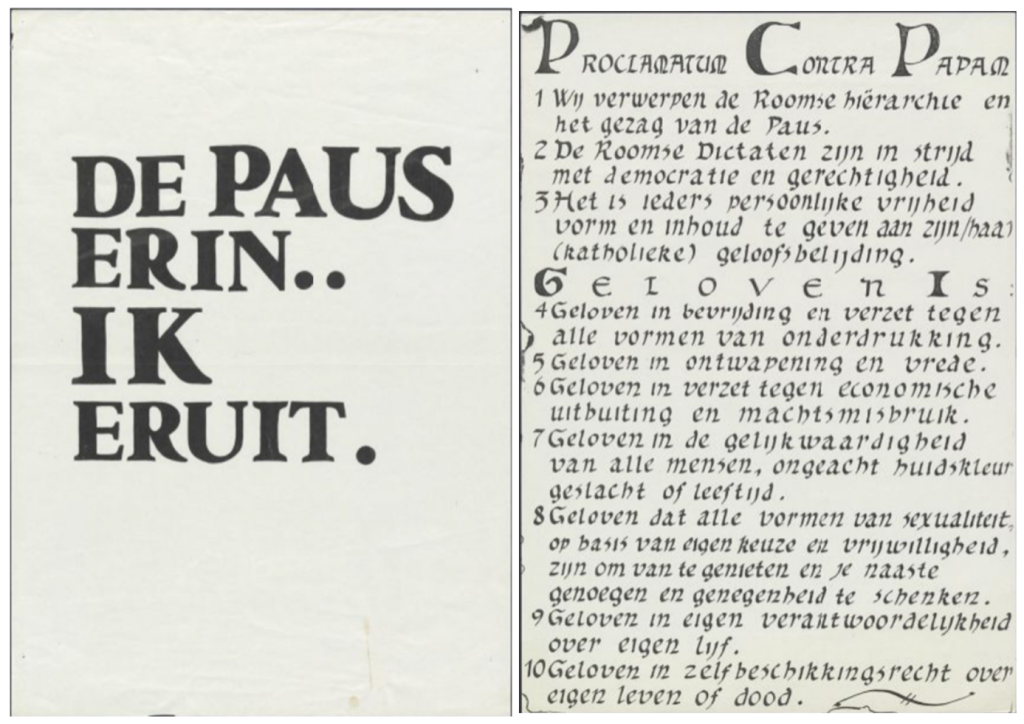
After selecting these objects, two main questions came up: who created these posters, and more importantly, why were they made? The aim of this research therefore became to examine the relationship between the queer community and the Catholic Church in the Netherlands around 1985 through constructing the narrative of the objects mentioned before. This narrative includes information about the context of the pope’s visit, within the Catholic Church and in society in general. In addition, I attempted to uncover as much information as possible about the objects themselves.
Finding information
Information about the societal context of the time around the pope’s visit, the prevailing sexual morality, and about the Catholic Church was retrieved from academic sources and books. In addition to this, I spoke with different persons, firstly, with a priest who was removed from office by the Catholic Church due to his homosexuality and presumed non-celibate lifestyle. In an open conversation, he gave me great insights into the time around the pope’s visit and about the relationship between the Catholic Church and the queer community.
Through him, I met with Henk Baars, a key figure in the 8 May-movement, which emerged in the time leading up to the pope’s visit. He provided a lot of information about the developments among Catholics at the time. He also made it very clear that there were two movements surrounding the pope’s visit: the uprising from Catholics themselves, and the uprising from the secular side. All the posters in this research originated from the secular side.
After many attempts to find contacts from this secular uprising, ultimately, Hans Dircks reached out and shared information about the secular events organized in Nijmegen during the pope’s visit in the country. The poster Proclamatum Contra Papam is likely created during one of these events.
In addition to the interviews conducted, I continued to search through other channels such as online sources and IHLIA’s own archive. The episodes of Andere Tijden about the pope’s visit and about the Pastoral Council of Noordwijkerhout provided many insights and clues for where to continue searching. IHLIA’s archive stores folders with newspaper clippings. Three folders were found that have information about the pope’s visit, specifically regarding the debates within, and on the queer community. The existence of these folders was discovered thanks to a memo at the end of the book Roomse Heisa by Gerard Reve, which includes his NRC columns about the pope’s visit. In addition to searches in IHLIA’s archive, other archives, such as IISG, the Utrecht Archives, the Amsterdam City Archives, and Delpher, were scanned at a surface level, using their online catalogues. I am convinced that more information must exist about the selected posters, but I was unable to find it through a preliminary scan. It may therefore be valuable for further research to explore these archives more deeply.
The posters were collected during a time when the origin of the object was not yet recorded, making it very difficult to trace provenance or the creator(s). However, two posters did provide information about their origin: the Lesbian Archive Nijmegen. This was a reason to try to retrieve information from sources from Nijmegen, such as the COC’s members’ magazine of Nijmegen, PINK, which is archived at IHLIA. This provided a lot of information on the posters and the organizations behind them.
Experiences of the research and IHLIA as an internship organization
I experienced the research at IHLIA as challenging and highly interesting. The approach employed for this research was completely new to me, because beforehand I could make no assumptions about possible outcomes, nor about the methods needed to uncover information. At times I felt like a detective following important leads, while at other moments I felt worn out because no matter how I searched, I could not find the information that would help me move forward.
I am grateful for the guidance I received from Thea during this research and for the relaxed attitude with which we could approach the project together, maintaining a curious and open mindset toward whatever information might come our way. I would also like to express my thanks to all the colleagues at IHLIA who offered many tips and advice and were always engaged and interested in my research. Whenever I needed something, they immediately stepped in to support me. I experienced the atmosphere and collaboration as very positive and pleasant.
Call for information
Finally, I want to invite the reader to share any additional information, particularly regarding the posters. As a researcher I am aware of the limitations of this research and that I might be missing out on valuable information. Together we can reshape history and (re)introduce the hidden stories of the historically marginalized. Therefore, if you know anything that could add to the story and enhance the information shared, please contact IHLIA: info@ihlia.nl
One poster particularly has no background information, so any information would be especially valuable.
Head photo: left: Poster Landelijke anti-pausdemonstratie / right: Poster Komitee anti-pausbezoek